
Forza offers one-on-one post-operative physiotherapy in downtown Vancouver. Your rehab follows your surgeon's protocol and is progressed on objective strength testing, so every step back is based on numbers.
Built around your surgeon's protocol
Strength measured with force plates and dynamometers
One-on-one with a registered physiotherapist
Not Sure You Are Ready for the Next Stage?

After surgery, the hardest part is knowing when to push and when to hold back.
Exercise sheets with little guidance
No way to see how the operated side compares
Forza post-op rehab measures your progress so every decision is clear.
Meet Your Physiotherapists
Forza is home to 4 registered physiotherapists who treat one-on-one.

Jordan Huhta
MScPT, Physiotherapist
He/Him/His
Jordan leads physiotherapy on the major trauma and orthopaedics unit at Vancouver General Hospital. He trained at Manchester Metropolitan University and studied Kinesiology at UBC.
Treats: orthopaedic and post-surgical injuries, lower-limb injuries, and ACL rehab.

Teala McEwan
MSc, Physiotherapy Physiotherapist
She/Her/Hers
Teala earned her Master's in Physiotherapy at Keele University and spent 3 years in private musculoskeletal practice in the UK.
Treats: musculoskeletal injuries and pelvic health, with added training in pelvic health physiotherapy, acupuncture, vestibular rehabilitation, and concussion management.

Justin Mazzei
MScPT, Physiotherapist and Co-Founder
He/Him/His
Justin completed a Master's in Physiotherapy at the University of Queensland and trained across Australia. He studied Kinesiology and Exercise Science at the University of the Fraser Valley.
Treats: return-to-sport, injury prevention, and overhead and running athletes, and offers dry needling.
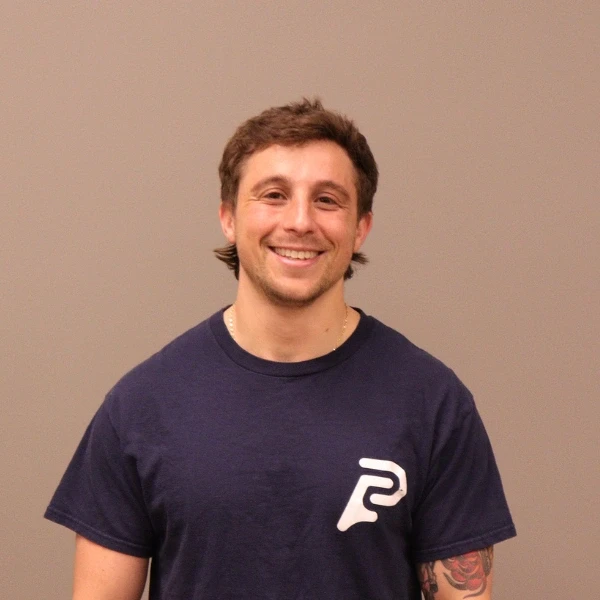
Marcel Wallace
MScPT, Physiotherapist and Co-Founder
He/Him/His
Marcel earned his Master's in Physiotherapy from Brunel University in the UK and moved to Canada in 2020. He is an Olympic weightlifter and lectures in orthopaedic pathology.
Treats: low back, shoulder, hip, knee, and ankle injuries, and strength athletes.
How force plate testing works. You stand, squat, jump or push on force plates while they record how much force each leg produces and how quickly. Dynamometers measure the strength of single muscle groups. The software compares your two sides and tracks the same numbers over time, so your physiotherapist can show you how your operated side compares with the other instead of estimating it.
Retesting at each stage shows when you are ready to progress. Rehab takes place on the full Evolve Strength gym floor, with tools like Blood Flow Restriction training that let you build strength with lighter loads when your surgeon's protocol limits what you can lift.
Related programs at Forza: ACL rehab and shoulder rehab after surgery. Read more about what force plates reveal about rehab.
